


Page 6 - Lesson Note 1
P. 6
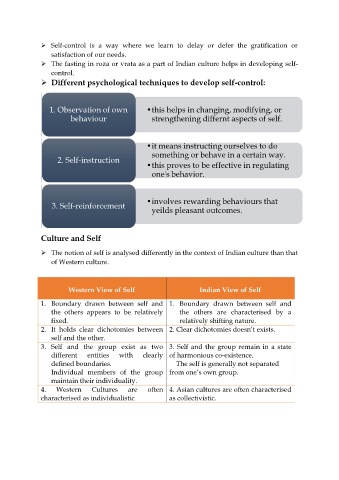
Self-control is a way where we learn to delay or defer the gratification or
satisfaction of our needs.
The fasting in roza or vrata as a part of Indian culture helps in developing self-
control.
Different psychological techniques to develop self-control:
1. Observation of own •this helps in changing, modifying, or
behaviour strengthening differnt aspects of self.
•it means instructing ourselves to do
something or behave in a certain way.
2. Self-instruction
•this proves to be effective in regulating
one's behavior.
•involves rewarding behaviours that
3. Self-reinforcement
yeilds pleasant outcomes.
Culture and Self
The notion of self is analysed differently in the context of Indian culture than that
of Western culture.
Western View of Self Indian View of Self
1. Boundary drawn between self and 1. Boundary drawn between self and
the others appears to be relatively the others are characterised by a
fixed. relatively shifting nature.
2. It holds clear dichotomies between 2. Clear dichotomies doesn’t exists.
self and the other.
3. Self and the group exist as two 3. Self and the group remain in a state
different entities with clearly of harmonious co-existence.
defined boundaries. The self is generally not separated
Individual members of the group from one’s own group.
maintain their individuality.
4. Western Cultures are often 4. Asian cultures are often characterised
characterised as individualistic as collectivistic.

