


Page 3 - Lesson Note 1
P. 3
1. Biological self
o When a new born baby who has no awareness of self, cries when its
hungry merely as a result of reflexes. Later leads to the development of
self-awareness, i.e “I am hungry”
2. Personal self
o This leads to an orientation in which one feels primarily concerned
with oneself.
o Aspects which relate to the concerned person is mainly emphasised
here, like., personal freedom, personal responsibility, personal
achievements, personal comforts.
3. Social self
o This emerges in relation with others and emphasises on aspects of life
such as, cooperation, unity, affiliation, sacrifice, support or sharing.
o This values family and social relationships.
o Also called as familial or relational self.
Module 2
Cognitive and Behavioural Aspects of self.
1. Self-Concept.
It’s the way we perceive ourselves.
These are the ideas we hold about our competencies and attributes.
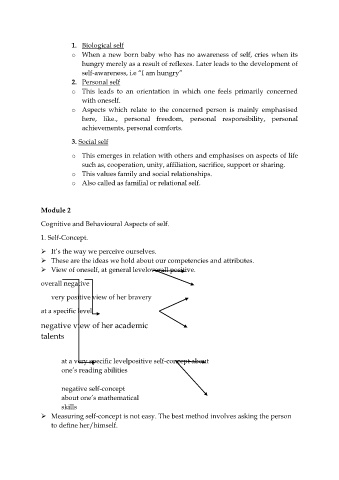
View of oneself, at general leveloverall positive.
overall negative
very positive view of her bravery
at a specific level
negative view of her academic
talents
at a very specific levelpositive self-concept about
one’s reading abilities
negative self-concept
about one’s mathematical
skills
Measuring self-concept is not easy. The best method involves asking the person
to define her/himself.

