


Page 8 - CLASS VII Lesson Notes Forces and Energy
P. 8
SUBTOPIC:  3.7 PARTICLES ON THE MOVE

        Key Words:
        diffusion, concentration

        What Is Diffusion?
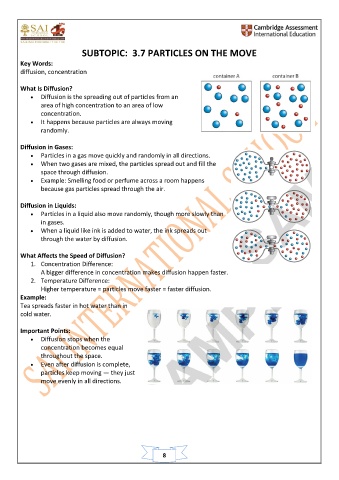
            •  Diffusion is the spreading out of particles from an
               area of high concentration to an area of low
               concentration.
            •  It happens because particles are always moving
               randomly.

        Diffusion in Gases:
            •  Particles in a gas move quickly and randomly in all directions.
            •  When two gases are mixed, the particles spread out and fill the
               space through diffusion.
            •  Example: Smelling food or perfume across a room happens
               because gas particles spread through the air.

        Diffusion in Liquids:
            •  Particles in a liquid also move randomly, though more slowly than
               in gases.
            •  When a liquid like ink is added to water, the ink spreads out
               through the water by diffusion.

        What Affects the Speed of Diffusion?
            1.  Concentration Difference:
               A bigger difference in concentration makes diffusion happen faster.
            2.  Temperature Difference:
               Higher temperature = particles move faster = faster diffusion.
        Example:
        Tea spreads faster in hot water than in
        cold water.

        Important Points:
            •  Diffusion stops when the
               concentration becomes equal
               throughout the space.
            •  Even after diffusion is complete,
               particles keep moving — they just
               move evenly in all directions.


                                                          8

