


Page 5 - CLASS VII Lesson Notes Forces and Energy
P. 5
SUBTOPIC: 3.4 Turning Forces


        Key Words: lever, pivot, moment, newton metres, turn
        Turning Effects of Forces:
            •  When you apply a force to something like a door handle, a bicycle pedal, or a spanner, it can cause
               the object to turn.
            •  A lever is an object that turns when a force is applied.
            •  The point around which the lever turns is called the pivot.


        Examples:
            •  A bicycle pedal turns around a pivot when you push it.
            •  Your arm acts as a lever and your elbow are the pivot when you bend it.
        Moments:
            •  A moment is the turning effect of a force around a pivot.
            •  The size of the moment depends on:
                   o  The size of the force
                   o  The distance from the pivot to where the force is applied
        Calculating Moment:
        Moment = Force × distance from pivot
            •  Force is measured in newtons (N)
            •  Distance is measured in metres (m)
            •  Moment is measured in newton metres (N m)
        Important: Write moment units with a capital N and lowercase m: Nm
        Worked Example 1:
        A force of 35 N is used to open a door. The distance from the handle to the pivot is 0.8 m.
        Solution:
        Moment = Force × distance from pivot
               = 35×0.8=28 Nm
        Worked Example 2:
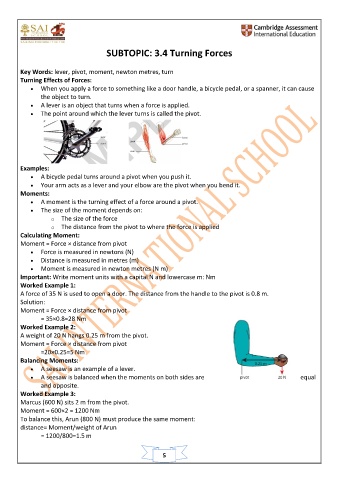
        A weight of 20 N hangs 0.25 m from the pivot.
        Moment = Force × distance from pivot
               =20×0.25=5 Nm
        Balancing Moments:
            •  A seesaw is an example of a lever.
            •  A seesaw is balanced when the moments on both sides are                                     equal
               and opposite.
        Worked Example 3:
        Marcus (600 N) sits 2 m from the pivot.
        Moment = 600×2 = 1200 Nm
        To balance this, Arun (800 N) must produce the same moment:
        distance= Moment/weight of Arun
               = 1200/800=1.5 m


                                                          5

