


Page 4 - CLASS VII Lesson Notes Forces and Energy
P. 4
SUBTOPIC: 3.3 Describing Movement


        Key Words: distance–time, graphs, sketch, at rest, stationary, safety precautions

        Understanding Distance–Time Graphs
            •  Scientists often use graphs to show how movement happens over time.
            •  A distance–time graph shows how far an object has travelled from the starting point as time passes.
            •  On these graphs:
                   Ø  Distance is on the vertical (y) axis
                   Ø  Time is on the horizontal (x) axis

        What Distance–Time Graphs Show
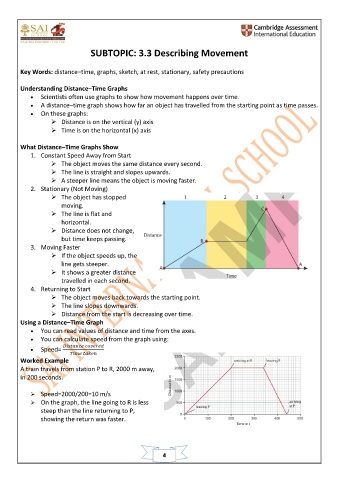
            1.  Constant Speed Away from Start
                   Ø  The object moves the same distance every second.
                   Ø  The line is straight and slopes upwards.
                   Ø  A steeper line means the object is moving faster.
            2.  Stationary (Not Moving)
                   Ø  The object has stopped
                       moving.
                   Ø  The line is flat and
                       horizontal.
                   Ø  Distance does not change,
                       but time keeps passing.
            3.  Moving Faster
                   Ø  If the object speeds up, the
                       line gets steeper.
                   Ø  It shows a greater distance
                       travelled in each second.
            4.  Returning to Start
                   Ø  The object moves back towards the starting point.
                   Ø  The line slopes downwards.
                   Ø  Distance from the start is decreasing over time.
        Using a Distance–Time Graph
            •  You can read values of distance and time from the axes.
            •  You can calculate speed from the graph using:

            •  Speed=  !"#$%&'(	'*+(,(-
                          0".(	$%/(&
        Worked Example
        A train travels from station P to R, 2000 m away,
        in 200 seconds.

            Ø  Speed=2000/200=10 m/s
            Ø  On the graph, the line going to R is less
               steep than the line returning to P,
               showing the return was faster.


                                                          4

