


Page 10 - Lesson Note
P. 10
You are a good boy.
She is my sister.
I have a pen.
Note 4:- When in doubt, look it up
in the dictionary, verbs will be listed as transitive, intransitive, or both right under the
pronunciation key, and any possible differences in meaning between the two uses will be
given as well.
Note 5:- An intransitive verb is the opposite of a transitive verb: it does not require an
object to act upon.
They jumped.
The dog ran.
She sang.
A light was shining
None of these verbs require an object for the sentence to make sense, and all of them can
end a sentence.
Note 6:- Some imperative forms of verbs can even make comprehensible one-word
sentences.
Run!
Sing!
Note 7:- -A number of English verbs can only be intransitive; that is, they will never make
sense paired with an object. Two examples of intransitive-only verbs are ‗arrive and die‟.
You can‘t arrive something, and you certainly can‘t die something.
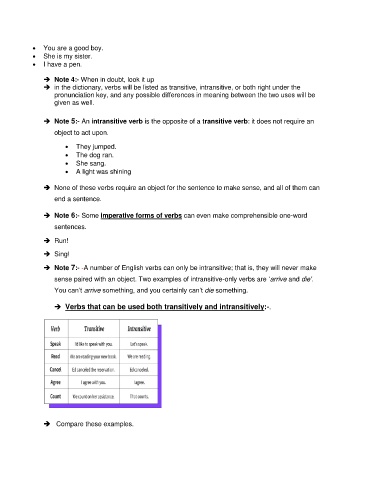
Verbs that can be used both transitively and intransitively:-.
Compare these examples.

