


Page 5 - Lesson Note
P. 5
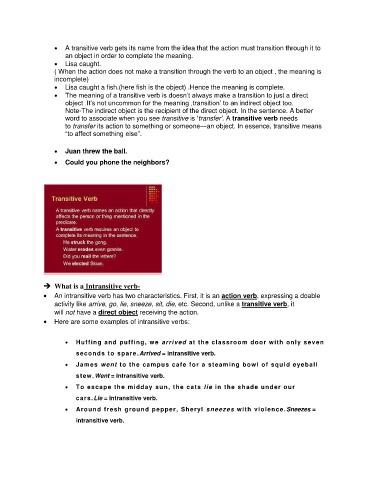
A transitive verb gets its name from the idea that the action must transition through it to
an object in order to complete the meaning.
Lisa caught.
( When the action does not make a transition through the verb to an object , the meaning is
incomplete)
Lisa caught a fish.(here fish is the object) .Hence the meaning is complete.
The meaning of a transitive verb is doesn‘t always make a transition to just a direct
object .It‘s not uncommon for the meaning ,transition‘ to an indirect object too.
Note-The indirect object is the recipient of the direct object. In the sentence. A better
word to associate when you see transitive is ‗transfer‟. A transitive verb needs
to transfer its action to something or someone—an object. In essence, transitive means
―to affect something else‖.
Juan threw the ball.
Could you phone the neighbors?
What is a Intransitive verb-
An intransitive verb has two characteristics. First, it is an action verb, expressing a doable
activity like arrive, go, lie, sneeze, sit, die, etc. Second, unlike a transitive verb, it
will not have a direct object receiving the action.
Here are some examples of intransitive verbs:
Huffing and puffing, we arrived at the classroom door with only seven
seconds to spare.Arrived = intransitive verb.
James went to the campus cafe for a steaming bowl of squid eyeball
stew.Went = intransitive verb.
To escape the midday sun, the cats lie in the shade under our
cars.Lie = intransitive verb.
Around fresh ground pepper, Sheryl sneezes with violence.Sneezes =
intransitive verb.

