


Page 4 - Microsoft Word - HA 1
P. 4
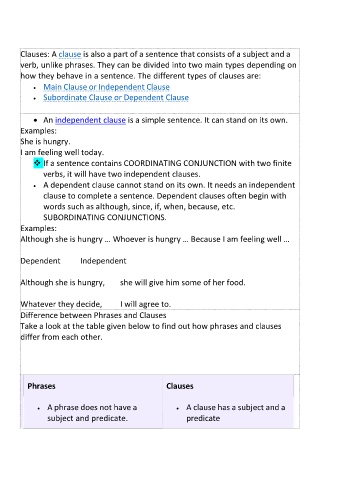
Clauses: A clause is also a part of a sentence that consists of a subject and a
verb, unlike phrases. They can be divided into two main types depending on
how they behave in a sentence. The different types of clauses are:
Main Clause or Independent Clause
Subordinate Clause or Dependent Clause
An independent clause is a simple sentence. It can stand on its own.
Examples:
She is hungry.
I am feeling well today.
If a sentence contains COORDINATING CONJUNCTION with two finite
verbs, it will have two independent clauses.
A dependent clause cannot stand on its own. It needs an independent
clause to complete a sentence. Dependent clauses often begin with
words such as although, since, if, when, because, etc.
SUBORDINATING CONJUNCTIONS.
Examples:
Although she is hungry … Whoever is hungry … Because I am feeling well …
Dependent Independent
Although she is hungry, she will give him some of her food.
Whatever they decide, I will agree to.
Difference between Phrases and Clauses
Take a look at the table given below to find out how phrases and clauses
differ from each other.
Phrases Clauses
A phrase does not have a A clause has a subject and a
subject and predicate. predicate

