


Page 3 - LN
P. 3
16                                                                 Accountancy

                       1.5.4 Liabilities

                       Liabilities are obligations or debts that an enterprise has to pay at some time in
                       the future. They represent creditors’ claims on the firm’s assets. Both small and
                       big businesses find it necessary to borrow money at one time or the other, and
                       to purchase goods on credit. Super Bazar, for example, purchases goods for Rs.
                       10,000 on credit for a month from Fast Food Products on March 25, 2005. If
                       the balance sheet of Super Bazaar is prepared as at March 31, 2005, Fast Food
                       Products will be shown as creditors on the liabilities side of the balance sheet. If
                       Super Bazaar takes a loan for a period of three years from Delhi State Co-operative
                       Bank, this will also be shown as a liability in the balance sheet of Super Bazaar.
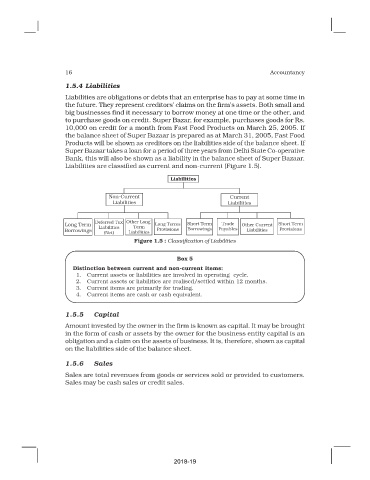
                       Liabilities are classified as current and non-current (Figure 1.5).
                                                         Liabilities


                                     Non-Current                             Current
                                      Liabilities                           Liabilities


                                Deferred Tax Other Long
                       Long Term             Term   Long Terms  Short Term  Trade  Other Current  Short Term
                      Borrowings  Liabilities        Provisions  Borrowings  Payables  Liabilities  Provisions
                                   (Net)    Liabilities
                                             Figure 1.5 : Classification of Liabilities


                                                            Box 5
                          Distinction between current and non-current items:
                          1.  Current assets or liabilities are involved in operating  cycle.
                          2.  Current assets or liabilities are realised/settled within 12 months.
                          3.  Current items are primarily for trading.
                          4.  Current items are cash or cash equivalent.


                       1.5.5    Capital

                       Amount invested by the owner in the firm is known as capital. It may be brought
                       in the form of cash or assets by the owner for the business entity capital is an
                       obligation and a claim on the assets of business. It is, therefore, shown as capital
                       on the liabilities side of the balance sheet.

                       1.5.6    Sales

                       Sales are total revenues from goods or services sold or provided to customers.
                       Sales may be cash sales or credit sales.


                                                           2018-19

