


Page 6 - LN3
P. 6
first time, they called it ‘shehnai’. So, the first part is ‘sheh’ which stands for ‘shah’ and the second
          part ‘nai’ that is a barber. So, this instrument was named as shehnai.

          The sound of the shehnai began to be considered auspicious.

          auspicious: promising to bring good fortune


          The sound which was produced by shehnai was considered to be a good omen. And so, it was
          played on good occasions.

          And for this reason it is still played in temples and is an indispensable component of any North
          Indian wedding.

          indispensable: without which a piece of work cannot be done, something which is necessary

          You can hear shehnai being played at many temples and at weddings also.


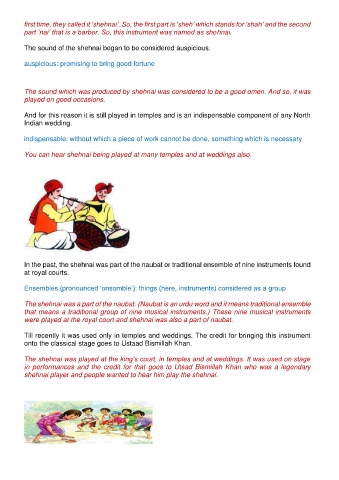
          In the past, the shehnai was part of the naubat or traditional ensemble of nine instruments found
          at royal courts.

          Ensembles (pronounced ‘onsomble’): things (here, instruments) considered as a group

          The shehnai was a part of the naubat. (Naubat is an urdu word and it means traditional ensemble
          that means a traditional group of nine musical instruments.) These nine musical instruments
          were played at the royal court and shehnai was also a part of naubat.

          Till recently it was used only in temples and weddings. The credit for bringing this instrument
          onto the classical stage goes to Ustaad Bismillah Khan.

          The shehnai was played at the king’s court, in temples and at weddings. It was used on stage
          in performances and the credit for that goes to Utsad Bismillah Khan who was a legendary
          shehnai player and people wanted to hear him play the shehnai.

