


Page 5 - LN3
P. 5
tonal quality: sound

          As  the  pungi  had  an  unpleasant  sound,  there  was  a  barber  who  belonged  to  a  family  of
          professional musicians and he wanted to play the pungi but he knew that the sound produced
          by pungi was unpleasant and so, he decided to improve the sound.

          He chose a pipe with a natural hollow stem that was longer and broader than the pungi, and
          made seven holes on the body of the pipe.
          hollow: empty from inside.

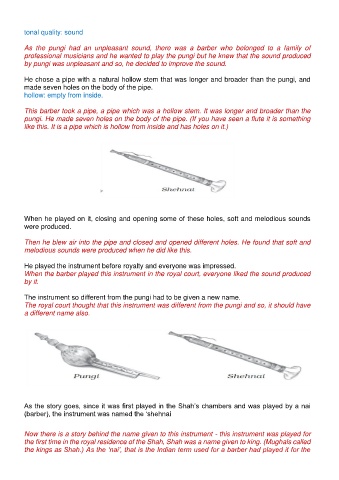
          This barber took a pipe, a pipe which was a hollow stem. It was longer and broader than the
          pungi. He made seven holes on the body of the pipe. (If you have seen a flute it is something
          like this. It is a pipe which is hollow from inside and has holes on it.)


          When he played on it, closing and opening some of these holes, soft and melodious sounds
          were produced.

          Then he blew air into the pipe and closed and opened different holes. He found that soft and
          melodious sounds were produced when he did like this.

          He played the instrument before royalty and everyone was impressed.
          When the barber played this instrument in the royal court, everyone liked the sound produced
          by it.

          The instrument so different from the pungi had to be given a new name.
          The royal court thought that this instrument was different from the pungi and so, it should have
          a different name also.


          As the story goes, since it was first played in the Shah’s chambers and was played by a nai
          (barber), the instrument was named the ‘shehnai

          Now there is a story behind the name given to this instrument - this instrument was played for
          the first time in the royal residence of the Shah, Shah was a name given to king. (Mughals called
          the kings as Shah.) As the ‘nai’, that is the Indian term used for a barber had played it for the

