


Page 2 - 2.1 lesson notes
P. 2
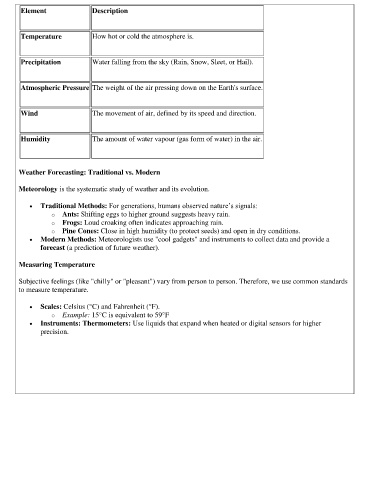
Element Description
Temperature How hot or cold the atmosphere is.
Precipitation Water falling from the sky (Rain, Snow, Sleet, or Hail).
Atmospheric Pressure The weight of the air pressing down on the Earth's surface.
Wind The movement of air, defined by its speed and direction.
Humidity The amount of water vapour (gas form of water) in the air.
Weather Forecasting: Traditional vs. Modern
Meteorology is the systematic study of weather and its evolution.
Traditional Methods: For generations, humans observed nature’s signals:
o Ants: Shifting eggs to higher ground suggests heavy rain.
o Frogs: Loud croaking often indicates approaching rain.
o Pine Cones: Close in high humidity (to protect seeds) and open in dry conditions.
Modern Methods: Meteorologists use "cool gadgets" and instruments to collect data and provide a
forecast (a prediction of future weather).
Measuring Temperature
Subjective feelings (like "chilly" or "pleasant") vary from person to person. Therefore, we use common standards
to measure temperature.
Scales: Celsius (°C) and Fahrenheit (°F).
o Example: 15°C is equivalent to 59°F
Instruments: Thermometers: Use liquids that expand when heated or digital sensors for higher
precision.

