


Page 3 - Lecon 3 Coco Chanel Lesson note
P. 3
Indirect Questions
               Interrogative adverbs can also be used in indirect questions, where the desire for
               information is found within a statement or command.
               Par exemple…
                     Je ne sais pas combien il travaille.      I don’t know how much he works.

                     Je veux savoir comment il va.           I want to know how he’s doing.

                     J’ai oublié où tu vas.                  I forgot where you’re going.
                     Je me demande pourquoi il a menti.     I wonder why he lied.

                     Dis-nous quand tu veux commencer.     Tell us when you want to start.


                                              Les verbes pronominaux


               Les verbes pronominaux (reflexive verbs) are always used with a reflexive pronoun (me, te,
               se, nous, vous, se) that agrees in number with the subject of the sentence. This pronoun
               always comes before the verb.


               How to conjugate reflexive verbs in French

               French Reflexive Pronouns

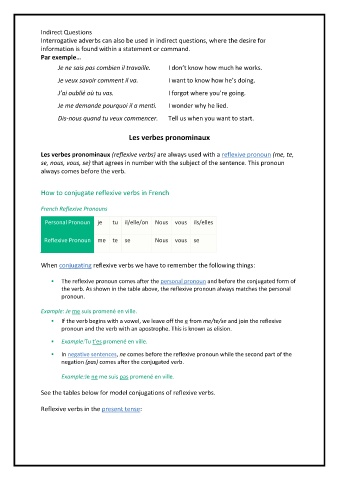
                 Personal Pronoun  je    tu  il/elle/on  Nous  vous  ils/elles


                 Reflexive Pronoun  me  te  se         Nous  vous  se


               When conjugating reflexive verbs we have to remember the following things:

                   ▪  The reflexive pronoun comes after the personal pronoun and before the conjugated form of
                       the verb. As shown in the table above, the reflexive pronoun always matches the personal
                       pronoun.


               Example: Je me suis promené en ville.
                   ▪  If the verb begins with a vowel, we leave off the e from me/te/se and join the reflexive
                       pronoun and the verb with an apostrophe. This is known as elision.
                   ▪  Example:Tu t’es promené en ville.

                   ▪  In negative sentences, ne comes before the reflexive pronoun while the second part of the
                       negation (pas) comes after the conjugated verb.

                       Example:Je ne me suis pas promené en ville.

               See the tables below for model conjugations of reflexive verbs.


               Reflexive verbs in the present tense:

