


Page 5 - 2- Lesson Notes- Health and its failure; Disease and its causes
P. 5
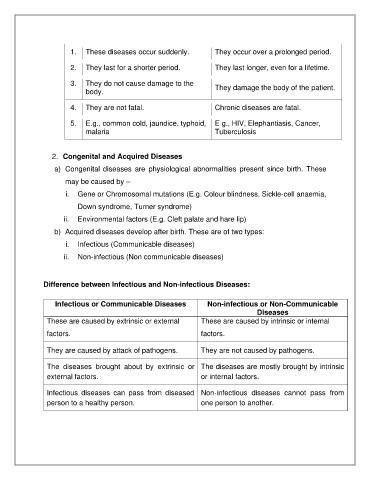
1.  These diseases occur suddenly.              They occur over a prolonged period.

                        2.  They last for a shorter period.             They last longer, even for a lifetime.

                        3.  They do not cause damage to the
                             body.                                      They damage the body of the patient.

                        4.  They are not fatal.                         Chronic diseases are fatal.


                        5.  E.g., common cold, jaundice, typhoid,  E g., HIV, Elephantiasis, Cancer,
                             malaria                                    Tuberculosis


                  2.  Congenital and Acquired Diseases

                   a)  Congenital diseases  are  physiological  abnormalities  present  since  birth.  These

                       may be caused by –
                       i.  Gene or Chromosomal mutations (E.g. Colour blindness, Sickle-cell anaemia,

                           Down syndrome, Turner syndrome)
                      ii.  Environmental factors (E.g. Cleft palate and hare lip)

                   b)  Acquired diseases develop after birth. These are of two types:

                       i.  Infectious (Communicable diseases)
                      ii.  Non-infectious (Non communicable diseases)


               Difference between Infectious and Non-infectious Diseases:

                   Infectious or Communicable Diseases                Non-infectious or Non-Communicable
                                                                                      Diseases
                 These are caused by extrinsic or external          These are caused by intrinsic or internal

                 factors.                                           factors.

                 They are caused by attack of pathogens.            They are not caused by pathogens.


                 The  diseases  brought  about  by  extrinsic  or  The diseases are mostly brought by intrinsic
                 external factors.                                  or internal factors.

                 Infectious  diseases  can  pass  from  diseased  Non-infectious  diseases  cannot  pass  from
                 person to a healthy person.                        one person to another.

