


Page 2 - 2. Lesson Notes- Movement and locomotion Part- II
P. 2
•   They have a streamlined body that makes it easy to move in air. The air cut
                      through the sides of the body and offers the least resistance.

                  •   The bones are hollow which makes the body lightweight and fit for flying.
                  •   Example of the birds with heavy bodies and cannot fly- Ostriches, penguins, and

                      emus.

                  •   The forelimbs of birds are modified to form wings for flight.
                  •   The body is covered with feathers that help them to fly and keep them warm.

                  •   The chest muscles are very strong that enable birds to flap their wings when

                      flying.
           Movement in snakes


               •  A snake slithers or crawls on the ground in a wave-like motion.
               •  They can move forward very fast but not in a straight line.
               •  They have a long and strong backbone with interconnected muscles that are joined
                  to the backbone and the ribs.
               •  The backbone is very flexible.
               •  They move in a wave-like motion and press against the ground with the help of
                  scales to push forward.
           Wonder box

               •  The hummingbird is the smallest bird in the world. It can hover in one place in the air
                  and can even fly backward,
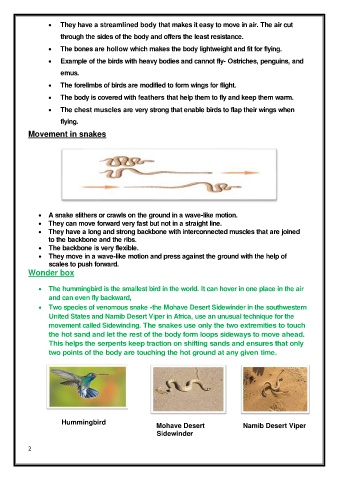
               •  Two species of venomous snake -the Mohave Desert Sidewinder in the southwestern
                  United States and Namib Desert Viper in Africa, use an unusual technique for the
                  movement called Sidewinding. The snakes use only the two extremities to touch
                  the hot sand and let the rest of the body form loops sideways to move ahead.
                  This helps the serpents keep traction on shifting sands and ensures that only
                  two points of the body are touching the hot ground at any given time.


                          Hummingbird
                                                         Mohave Desert                 Namib Desert Viper
                                                        Sidewinder

           2

