


Page 2 - LN 5
P. 2
A rectangle is a 2-dimensional shape/polygon with four sides, four vertices, and
               four right angles. The two opposite sides in the rectangle are equal and parallel to
               each other. The area of a rectangle is the space covered by the shape. Alternatively,
               the space within the perimeter of the rectangle is the area of a rectangle.
               Some examples of rectangular figures are agricultural fields, parks, tiles, daily life
               objects such as pans, glass, table, serving tray, etc.


               Calculating the area of a rectangle
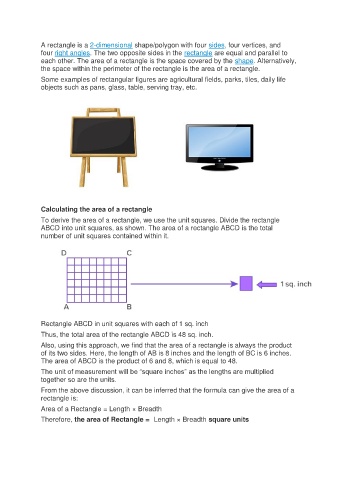
               To derive the area of a rectangle, we use the unit squares. Divide the rectangle
               ABCD into unit squares, as shown. The area of a rectangle ABCD is the total
               number of unit squares contained within it.


               Rectangle ABCD in unit squares with each of 1 sq. inch
               Thus, the total area of the rectangle ABCD is 48 sq. inch.

               Also, using this approach, we find that the area of a rectangle is always the product
               of its two sides. Here, the length of AB is 8 inches and the length of BC is 6 inches.
               The area of ABCD is the product of 6 and 8, which is equal to 48.

               The unit of measurement will be “square inches” as the lengths are multiplied
               together so are the units.

               From the above discussion, it can be inferred that the formula can give the area of a
               rectangle is:

               Area of a Rectangle = Length × Breadth

               Therefore, the area of Rectangle =  Length × Breadth square units

