


Page 2 - ln1
P. 2
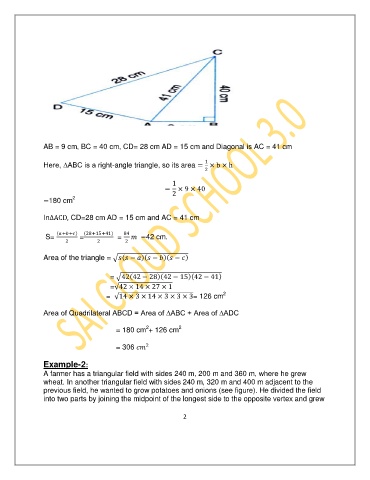
AB = 9 cm, BC = 40 cm, CD= 28 cm AD = 15 cm and Diagonal is AC = 41 cm


                                                                     1
               Here, ∆ABC is a right-angle triangle, so its area = × b × h
                                                                     2
                                                          1
                                                        =   × 9 × 40
                                                          2
               =180 cm   2


               In∆ACD, CD=28 cm AD = 15 cm and AC = 41 cm


                S=     +  +     =  28+15+41    =  84      =42 cm.
                       2         2        2

               Area of the triangle =        −        −        −


                                                =  42 42 − 28  42 − 15  42 − 41
                                                = 42 × 14 × 27 × 1
                                                                           2
                                              =   14 × 3 × 14 × 3 × 3 × 3= 126 cm

               Area of Quadrilateral ABCD = Area of ∆ABC + Area of ∆ADC

                                                 2
                                                            2
                                       = 180 cm + 126 cm
                                                 2
                                       = 306
               Example-2:
               A farmer has a triangular field with sides 240 m, 200 m and 360 m, where he grew
               wheat. In another triangular field with sides 240 m, 320 m and 400 m adjacent to the
               previous field, he wanted to grow potatoes and onions (see figure). He divided the field
               into two parts by joining the midpoint of the longest side to the opposite vertex and grew


                                                              2

