


Page 1 - Lesson Notes
P. 1
SAI International School
Subject- Biology, Class- IX
Topic- The Fundamental Unit of Life
Subtopic- Plastids, Vacuoles
Module- 7
LESSON NOTES
PLASTIDS
Plastids are the large cell organelles found only in plants which are
specialized to synthesize and store organic substances.
It is of two different types:
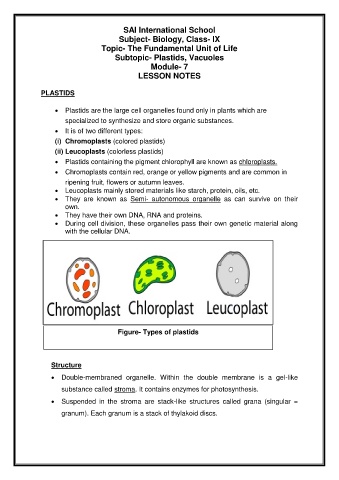
(i) Chromoplasts (colored plastids)
(ii) Leucoplasts (colorless plastids)
Plastids containing the pigment chlorophyll are known as chloroplasts.
Chromoplasts contain red, orange or yellow pigments and are common in
ripening fruit, flowers or autumn leaves.
Leucoplasts mainly stored materials like starch, protein, oils, etc.
They are known as Semi- autonomous organelle as can survive on their
own.
They have their own DNA, RNA and proteins.
During cell division, these organelles pass their own genetic material along
with the cellular DNA.
Figure- Types of plastids
Structure
Double-membraned organelle. Within the double membrane is a gel-like
substance called stroma. It contains enzymes for photosynthesis.
Suspended in the stroma are stack-like structures called grana (singular =
granum). Each granum is a stack of thylakoid discs.

