


Page 2 - Lesson Notes
P. 2
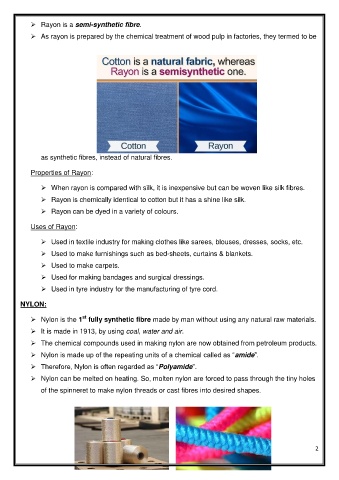
Rayon is a semi-synthetic fibre.
As rayon is prepared by the chemical treatment of wood pulp in factories, they termed to be
as synthetic fibres, instead of natural fibres.
Properties of Rayon:
When rayon is compared with silk, it is inexpensive but can be woven like silk fibres.
Rayon is chemically identical to cotton but it has a shine like silk.
Rayon can be dyed in a variety of colours.
Uses of Rayon:
Used in textile industry for making clothes like sarees, blouses, dresses, socks, etc.
Used to make furnishings such as bed-sheets, curtains & blankets.
Used to make carpets.
Used for making bandages and surgical dressings.
Used in tyre industry for the manufacturing of tyre cord.
NYLON:
st
Nylon is the 1 fully synthetic fibre made by man without using any natural raw materials.
It is made in 1913, by using coal, water and air.
The chemical compounds used in making nylon are now obtained from petroleum products.
Nylon is made up of the repeating units of a chemical called as “amide”.
Therefore, Nylon is often regarded as “Polyamide”.
Nylon can be melted on heating. So, molten nylon are forced to pass through the tiny holes
of the spinneret to make nylon threads or cast fibres into desired shapes.
2

