


Page 2 - Lesson Notes
P. 2
Then it is a final good, whereas, if a good is used for:
               (i) Further processing; or
               (ii) Resale in the same year, then it is known as intermediate good.
               Thus, the basis of classification between these two goods is not the commodity itself,
               but the use made of it.
               For example, bread used by a consumer household is a final goods, but the same used
               by a bakery for making a sandwich is a intermediate goods.
               (b) Production Boundary
               (i) Production boundary plays a vital role to differentiate between intermediate and final
               goods. The production boundary is the imaginary line around the production unit.
               (ii) According to the production boundary, if a good crosses the imaginary line around
               the production unit and reaches to final consumer or investment made by a producer
               within the imaginary line of production unit, it is known as final good.
               As against it, if a good does not cross the imaginary line around the production unit and
               reaches to other firm within the production boundary, it is known as intermediate good.


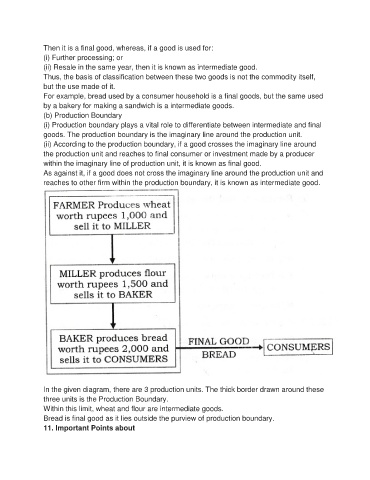
               In the given diagram, there are 3 production units. The thick border drawn around these
               three units is the Production Boundary.
               Within this limit, wheat and flour are intermediate goods.
               Bread is final good as it lies outside the purview of production boundary.
               11. Important Points about

