


Page 1 - Mind Map
P. 1
wa
Chapter – India’s Foreign Policy Os
al
CB
He exercised profound control in the SE
formulation and implementation of
Ch
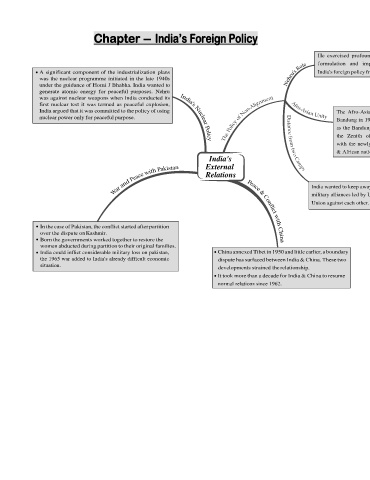
A significant component of the industrialization plans India's foreign policy from 1916 to 1964. apt
was the nuclear programme initiated in the late 1940s erw
under the guidance of Homi J Bhabha. India wanted to ise
generate atomic energy for peaceful purposes. Nehru
was against nuclear weapons when India conducted its
first nuclear test it was termed as peaceful explosion,
India argued that it was committed to the policy of using The Afro-Asian Conference held in Mind
nuclear power only for peaceful purpose. Bandung in 1955, commonly known
as the Bandung Conference, marked Maps,
the Zenith of India's engagement
Po
with the newly independent Asian lit
& African nations. ic
India's al
n External
Relations
Sci
India wanted to keep away from the en
military alliances led by US and Soviet ce
Union against each other.
,
Cla
ss
In the case of Pakistan, the conflict started after partition
over the dispute on Kashmir. –
Born the governments worked together to restore the XII
women abducted during partition to their original families.
India could inflict considerable military loss on pakistan, China annexed Tibet in 1950 and little earlier, a boundary
the 1965 war added to India's already difficult economic dispute has surfaced between India & China. These two
situation.
developments strained the relationship.
It took more than a decade for India & China to resume
normal relations since 1962.
[
13

