


Page 4 - Lesson Note 1
P. 4
call money rates makes other sources of finance such as commercial paper and certificates of
               deposit cheaper in comparison for banks raise funds from these sources.


               4.  Certificate  of  Deposit:  Certificates  of  deposit  (CD)  are  unsecured,  negotiable,  short-term
               instruments in bearer form, issued by commercial banks and development financial institutions.
               They can be issued to individuals, corporations and companies during periods of tight liquidity
               when  the  deposit  growth  of  banks  is  slow  but  the  demand  for  credit  is  high.  They  help  to
               mobilize a large amount of money for short periods.

               5. Commercial Bill: A commercial bill is a bill of exchange used to finance the working capital

               requirements of business firms. It is a short-term, negotiable, self-liquidating instrument which
               is used to finance the credit sales of firms. When goods are sold on credit, the buyer becomes
               liable to make payment on a specific date in future. The seller could wait till the specified date
               or make use of a bill of exchange. The seller (drawer) of the goods draws the bill and the buyer
               (drawee) accepts it. On being accepted, the bill becomes a marketable instrument and is called
               a trade bill. These bills can be discounted with a bank if the seller needs funds before the bill
               matures. When a trade bill is accepted by a commercial bank it is known as a commercial bill.


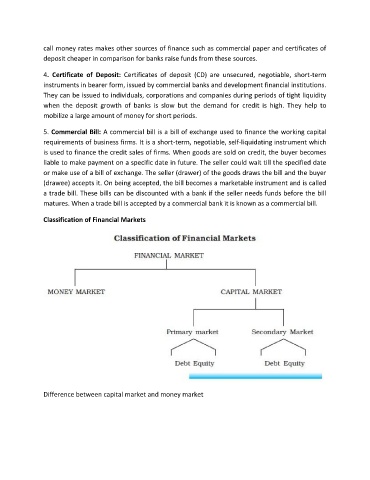
               Classification of Financial Markets


               Difference between capital market and money market

