


Page 3 - 2.1-Lesson Notes-Animal Nervous System, Reflex Action
P. 3
•  The nervous tissue is made up of an organized network of nerve cells or neurons,
                 and is specialized for conducting information via electrical impulses from one part
                 of the body to another.
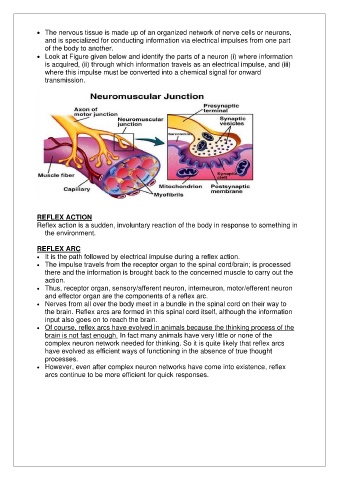
              •  Look at Figure given below and identify the parts of a neuron (i) where information
                 is acquired, (ii) through which information travels as an electrical impulse, and (iii)
                 where this impulse must be converted into a chemical signal for onward
                 transmission.


              REFLEX ACTION
              Reflex action is a sudden, involuntary reaction of the body in response to something in
                 the environment.

              REFLEX ARC
              •  It is the path followed by electrical impulse during a reflex action.
              •  The impulse travels from the receptor organ to the spinal cord/brain; is processed
                 there and the information is brought back to the concerned muscle to carry out the
                 action.
              •  Thus, receptor organ, sensory/afferent neuron, interneuron, motor/efferent neuron
                 and effector organ are the components of a reflex arc.
              •  Nerves from all over the body meet in a bundle in the spinal cord on their way to
                 the brain. Reflex arcs are formed in this spinal cord itself, although the information
                 input also goes on to reach the brain.
              •  Of course, reflex arcs have evolved in animals because the thinking process of the
                 brain is not fast enough. In fact many animals have very little or none of the
                 complex neuron network needed for thinking. So it is quite likely that reflex arcs
                 have evolved as efficient ways of functioning in the absence of true thought
                 processes.
              •  However, even after complex neuron networks have come into existence, reflex
                 arcs continue to be more efficient for quick responses.

