


Page 5 - 7.2 LN
P. 5
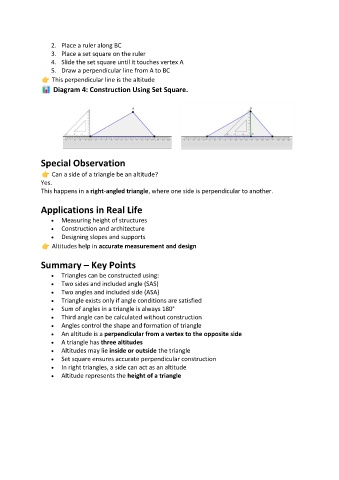
2.  Place a ruler along BC
                   3.  Place a set square on the ruler
                   4.  Slide the set square until it touches vertex A
                   5.  Draw a perpendicular line from A to BC
                 This perpendicular line is the altitude


                 Diagram 4: Construction Using Set Square.


               Special Observation


                 Can a side of a triangle be an altitude?


               Yes.
               This happens in a right-angled triangle, where one side is perpendicular to another.

               Applications in Real Life

                   •  Measuring height of structures
                   •  Construction and architecture
                   •  Designing slopes and supports
                 Altitudes help in accurate measurement and design


               Summary – Key Points
                   •  Triangles can be constructed using:
                   •  Two sides and included angle (SAS)
                   •  Two angles and included side (ASA)
                   •  Triangle exists only if angle conditions are satisfied
                   •  Sum of angles in a triangle is always 180°
                   •  Third angle can be calculated without construction
                   •  Angles control the shape and formation of triangle
                   •  An altitude is a perpendicular from a vertex to the opposite side
                   •  A triangle has three altitudes
                   •  Altitudes may lie inside or outside the triangle
                   •  Set square ensures accurate perpendicular construction
                   •  In right triangles, a side can act as an altitude
                   •  Altitude represents the height of a triangle

