


Page 2 - CL-8 CH-1CBQ
P. 2
8    What is the maximum number of obtuse angles that a quadrilateral can have?
                    ANSWER: 3
               9    In a parallelogram PQRS, if ∠P = (3x − 5)° and ∠Q = (2x + 15)°, then find the value of x.
                    ANSWER: 34
               10  If one angle of a parallelogram is 24  less than twice the smallest angle then, find the
                                                       0
                    largest angle of the parallelogram.
                    ANSWER: 52
               11  The interior angle of a regular polygon is four times its exterior angle. How many sides
                    does the polygon have?
                    ANSWER: 10
               12  In quadrilaterals,
                    (i) which of them have their diagonals bisecting each other?
                    (ii) which of them have their diagonal perpendicular to each other?
                    (iii) which of them have equal diagonals?
                    ANSWER:
                   i.      Parallelogram, Rhombus, Rectangle, Square, Kite
                  ii.      Rhombus, Square, Kite
                  iii.     Rectangle, Square.

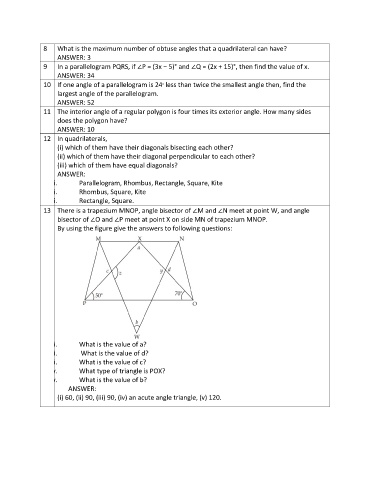
               13  There is a trapezium MNOP, angle bisector of ∠M and ∠N meet at point W, and angle
                    bisector of ∠O and ∠P meet at point X on side MN of trapezium MNOP.
                    By using the figure give the answers to following questions:


                   i.      What is the value of a?
                  ii.       What is the value of d?
                  iii.     What is the value of c?
                  iv.      What type of triangle is POX?
                  v.       What is the value of b?
                        ANSWER:
                    (i) 60, (ii) 90, (iii) 90, (iv) an acute angle triangle, (v) 120.

