


Page 1 - X-CBQ-Worksheet-LIGHT
P. 1
SAI INTERNATIONAL SCHOOL, BHUBANESWAR

                                         COMPETENCY BASED WORKSHEET
                                                        CLASS X
                                CHAPTER – LIGHT REFELCTION AND REFRACTION


           SL NO     QUESTIONS                                                                   MARKS
                     For question 1 To 4 two statements are given. One labelled Assertion (A) and the
                     other labelled Reason(R). Select the correct answer to these questions from the codes
                     (a) , (b), (c) and (d) as given below:
                     (a) Both A and R are true and R is the correct explanation of the assertion.
                     (b) Both A and R are true, but R is not the correct explanation of the assertion.
                     (c) A is true, but R is false.
                     (d) A is false, but R is true.
                     (e) A and R are false.
              1.    Assertion (A) : A ray passing through the centre of curvature of a concave   1
                     mirror after reflection, is reflected back along the same path.
                     Reason (R) : The incident rays fall on the mirror along the normal to the
                     reflecting surface.
              2.    Assertion: Linear magnification of a mirror has no unit.                     1
                     Reason: The ratio of height of the image to the height of the object is the
                     linear magnification produced by mirror.
              3.    Assertion: Refractive index of glass with respect to air is different for red   1
                     light and violet light.
                     Reason : Refractive index of a pair of media depends on the wavelength of
                     light used.
              4.    Assertion (A): The refractive index of a medium determines the extent of     1
                     bending of light.
                     Reason (R): The refractive index is a measure of how much a medium can
                     slow down the speed of light and is directly related to the angle of
                     refraction.
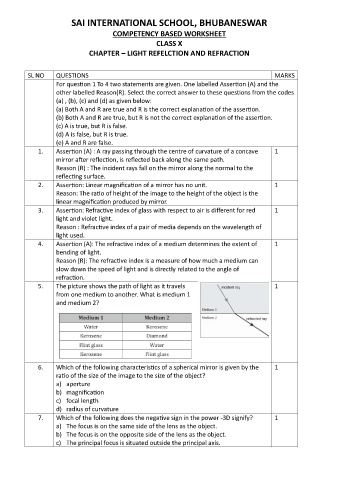
              5.    The picture shows the path of light as it travels                            1
                     from one medium to another. What is medium 1
                     and medium 2?


              6.    Which of the following characteristics of a spherical mirror is given by the   1
                     ratio of the size of the image to the size of the object?
                     a)  aperture
                     b)  magnification
                     c)  focal length
                     d)  radius of curvature
              7.    Which of the following does the negative sign in the power -3D signify?      1
                     a)  The focus is on the same side of the lens as the object.
                     b)  The focus is on the opposite side of the lens as the object.
                     c)  The principal focus is situated outside the principal axis.

