


Page 34 - 01. Classification of living things - Biology Notes IGCSE
P. 34
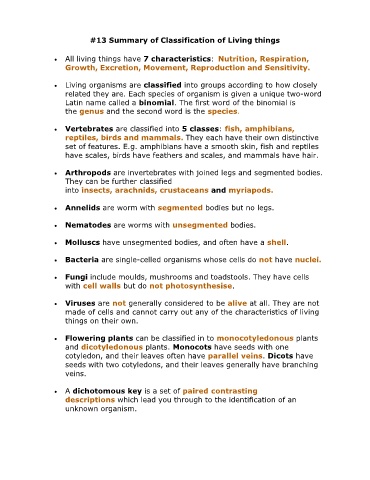
#13 Summary of Classification of Living things

                   •  All living things have 7 characteristics:  Nutrition, Respiration,
                       Growth, Excretion, Movement, Reproduction and Sensitivity.

                   •  Living organisms are classified into groups according to how closely
                       related they are. Each species of organism is given a unique two-word
                       Latin name called a binomial. The first word of the binomial is
                       the genus and the second word is the species.


                   •  Vertebrates are classified into 5 classes: fish, amphibians,
                       reptiles, birds and mammals. They each have their own distinctive
                       set of features. E.g. amphibians have a smooth skin, fish and reptiles
                       have scales, birds have feathers and scales, and mammals have hair.


                   •  Arthropods are invertebrates with joined legs and segmented bodies.
                       They can be further classified
                       into insects, arachnids, crustaceans and myriapods.


                   •  Annelids are worm with segmented bodies but no legs.

                   •  Nematodes are worms with unsegmented bodies.


                   •  Molluscs have unsegmented bodies, and often have a shell.


                   •  Bacteria are single-celled organisms whose cells do not have nuclei.

                   •  Fungi include moulds, mushrooms and toadstools. They have cells
                       with cell walls but do not photosynthesise.


                   •  Viruses are not generally considered to be alive at all. They are not
                       made of cells and cannot carry out any of the characteristics of living
                       things on their own.


                   •  Flowering plants can be classified in to monocotyledonous plants
                       and dicotyledonous plants. Monocots have seeds with one
                       cotyledon, and their leaves often have parallel veins. Dicots have
                       seeds with two cotyledons, and their leaves generally have branching
                       veins.


                   •  A dichotomous key is a set of paired contrasting
                       descriptions which lead you through to the identification of an
                       unknown organism.

