


Page 3 - Lesson Notes-Ch.13 SA and Volumes(Cuboids and Cubes)
P. 3
A solid having its length, breadth, height all to be equal in measurement is
                   called a cube.  A cube is a solid bounded by six square plane regions,
                   where the side of the cube is called edge.

                   Properties of a Cuboid
                   Let us discuss the properties of cuboid based on its faces, base and lateral
                   faces, edges and vertices.

                   Faces of Cuboid
                   A Cuboid is made up of six rectangles, each of the rectangles is called the
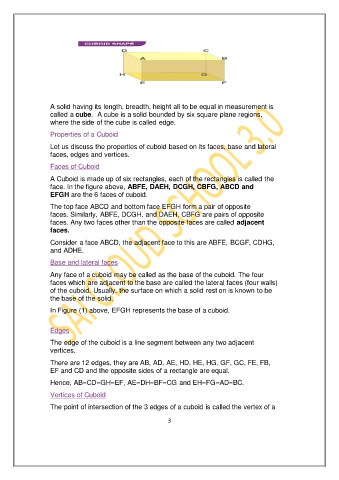
                   face. In the figure above, ABFE, DAEH, DCGH, CBFG, ABCD and
                   EFGH are the 6 faces of cuboid.
                   The top face ABCD and bottom face EFGH form a pair of opposite
                   faces. Similarly, ABFE, DCGH, and DAEH, CBFG are pairs of opposite
                   faces. Any two faces other than the opposite faces are called adjacent
                   faces.
                   Consider a face ABCD, the adjacent face to this are ABFE, BCGF, CDHG,
                   and ADHE.

                   Base and lateral faces
                   Any face of a cuboid may be called as the base of the cuboid. The four
                   faces which are adjacent to the base are called the lateral faces (four walls)
                   of the cuboid. Usually, the surface on which a solid rest on is known to be
                   the base of the solid.

                   In Figure (1) above, EFGH represents the base of a cuboid.


                   Edges
                   The edge of the cuboid is a line segment between any two adjacent
                   vertices.

                   There are 12 edges, they are AB, AD, AE, HD, HE, HG, GF, GC, FE, FB,
                   EF and CD and the opposite sides of a rectangle are equal.

                   Hence, AB=CD=GH=EF, AE=DH=BF=CG and EH=FG=AD=BC.

                   Vertices of Cuboid
                   The point of intersection of the 3 edges of a cuboid is called the vertex of a


                                                            3

