


Page 3 - LN
P. 3
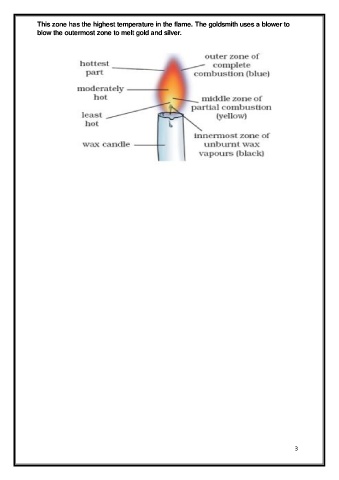
Structure of a flame

       A flame consists of three zones. These
       are the innermost zone, middle zone, and
       the outermost zone.

         I.   The innermost zone of a flame is
              dark. It consists of hot, unburnt
              vapours of the combustible
              material. It is the least hot zone of
              the flame.
        II.   The middle zone of a flame is
              yellow. It is bright and luminous.
              The fuel burns partially in the
              middle zone because there is not
              enough air for burning in this zone.
              The partial burning of fuel in this
              zone produces carbon particles. These particles become hot  and emit light.
        III.   The outermost zone of a flame is blue. It is a non-luminous zone. In this zone,
              complete combustion of the fuel takes place because there is plenty of air around it.
              This zone has the highest temperature in the flame. The goldsmith uses a blower to
              blow the outermost zone to melt gold and silver

