


Page 1 - 1. Transportation of substances in animals
P. 1
SAI International School

                                               Subject- Biology, Class-VII
                                         Topic- Transportation and Excretion
                                Subtopic- Transportation of substances in organisms
                                                       Lesson Notes

               Transportation in Unicellular Organisms:
                   •  In unicellular organisms such as Amoeba and Paramecium, transportation of substances
                       happens through diffusion and osmosis.
                   •  No specialised transportation system is present in such organisms.

               Transportation in Multicellular Organisms:
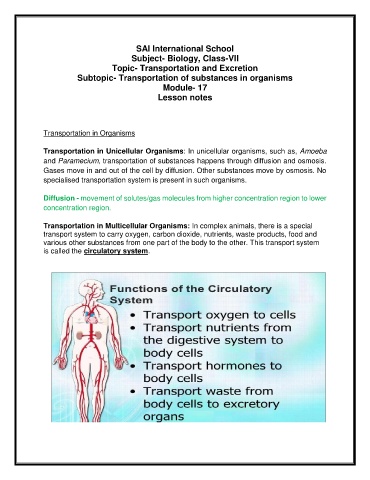
                   •  Special transport system to carry oxygen, carbon dioxide, nutrients, waste products,
                       food, and various other substances from one part of the body to the other.


                 Know more:


                 Diffusion: Diffusion is the process by which particles move from a region of higher concentration
                 to a region of lower concentration until they are evenly spread out.


                 Osmosis: Osmosis is the movement of water molecules from a region of higher water

                 concentration to a region of lower water concentration through a semi-permeable membrane.


                       Circulatory system in Human Beings:
                          •  The circulatory system in humans is composed of three main components, viz.
                              heart, blood vessels and blood.
                          •  Help in transportation of nutrients, respiratory gases, various enzymes and
                              hormones to body cells.
                          •  Transportation of wastes from body cells to excretory organs.
               Blood:

                   1.  PLASMA:
                          •  Plasma makes the liquid part of the blood.
                          •  It is 90% water and rest 10% salts, digested food, proteins, waste materials etc.
                   2.  BLOOD CELLS:
                    a)  Red Blood Cells or Red Blood Corpuscles (RBC):
                           •  biconcave disc-like structures
                           •  lifespan: 120 days
                           •  contains haemoglobin that gives blood red colour and binds with oxygen to form
                              oxyhaemoglobin

