


Page 2 - LN
P. 2
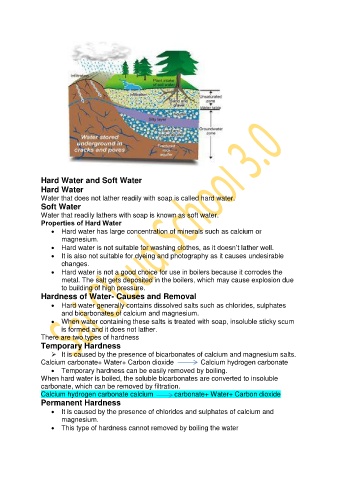
Hard Water and Soft Water
Hard Water
Water that does not lather readily with soap is called hard water.
Soft Water
Water that readily lathers with soap is known as soft water.
Properties of Hard Water
Hard water has large concentration of minerals such as calcium or
magnesium.
Hard water is not suitable for washing clothes, as it doesn’t lather well.
It is also not suitable for dyeing and photography as it causes undesirable
changes.
Hard water is not a good choice for use in boilers because it corrodes the
metal. The salt gets deposited in the boilers, which may cause explosion due
to building of high pressure.
Hardness of Water- Causes and Removal
Hard water generally contains dissolved salts such as chlorides, sulphates
and bicarbonates of calcium and magnesium.
When water containing these salts is treated with soap, insoluble sticky scum
is formed and it does not lather.
There are two types of hardness
Temporary Hardness
It is caused by the presence of bicarbonates of calcium and magnesium salts.
Calcium carbonate+ Water+ Carbon dioxide Calcium hydrogen carbonate
Temporary hardness can be easily removed by boiling.
When hard water is boiled, the soluble bicarbonates are converted to insoluble
carbonate, which can be removed by filtration.
Calcium hydrogen carbonate calcium carbonate+ Water+ Carbon dioxide
Permanent Hardness
It is caused by the presence of chlorides and sulphates of calcium and
magnesium.
This type of hardness cannot removed by boiling the water

