


Page 2 - 3-Lesson Note-Reversible and Irreversible Changes
P. 2
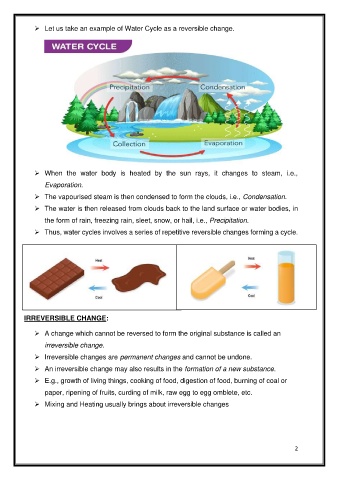
➢  Let us take an example of Water Cycle as a reversible change.


             ➢  When  the  water  body  is  heated  by  the  sun  rays,  it  changes  to  steam,  i.e.,

                 Evaporation.
             ➢  The vapourised steam is then condensed to form the clouds, i.e., Condensation.

             ➢  The water is then released from clouds back to the land surface or water bodies, in

                 the form of rain, freezing rain, sleet, snow, or hail, i.e., Precipitation.
             ➢  Thus, water cycles involves a series of repetitive reversible changes forming a cycle.


          IRREVERSIBLE CHANGE:

             ➢  A change which cannot be reversed to form the original substance is called an

                 irreversible change.
             ➢  Irreversible changes are permanent changes and cannot be undone.

             ➢  An irreversible change may also results in the formation of a new substance.

             ➢  E.g., growth of living things, cooking of food, digestion of food, burning of coal or
                 paper, ripening of fruits, curding of milk, raw egg to egg omblete, etc.

             ➢  Mixing and Heating usually brings about irreversible changes


                                                                                                         2

