


Page 1 - 11.1 THE MOON INTRODUCTION
P. 1
CHAPTER 11: THE MOON
TOPIC: INTRODUCTION TO THE MOON, SURFACE AND CONDITION
The Moon
The Moon is an astronomical body orbiting Earth and is the planet's only natural
satellite.
The gravitational attraction between the earth and the natural satellite holds it in its
orbit even as the moon revolves around the earth.
It is the fifth-largest satellite in the Solar System, and by far the largest among
planetary satellites relative to the size of the planet that it orbits.
The Moon is thought to have formed about 4.51 billion years ago, not long after
Earth.
The Moon is in synchronous rotation with Earth, and thus always shows the same
side to Earth, the near side. Because of liberation, slightly more than half (about
59%) of the total lunar surface can be viewed from Earth.
After the Sun, the Moon is the second-brightest celestial object regularly visible in
Earth's sky.
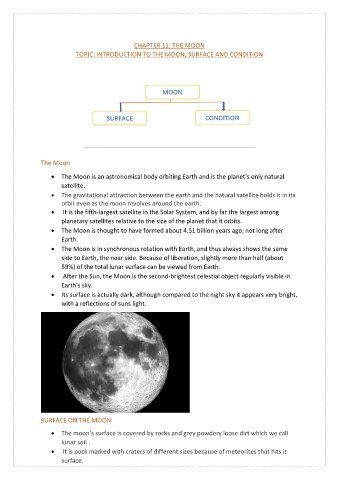
Its surface is actually dark, although compared to the night sky it appears very bright,
with a reflections of suns light.
SURFACE ON THE MOON
The moon’s surface is covered by rocks and grey powdery loose dirt which we call
lunar soil .
It is pock marked with craters of different sizes because of meteorites that hits it
surface.

