


Page 2 - 9.5 Ears and Nose
P. 2
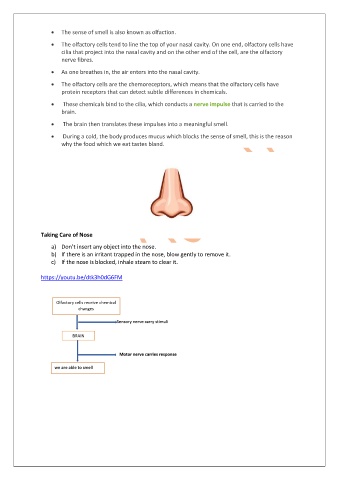
•  The sense of smell is also known as olfaction.

                   •  The olfactory cells tend to line the top of your nasal cavity. On one end, olfactory cells have
                       cilia that project into the nasal cavity and on the other end of the cell, are the olfactory
                       nerve fibres.

                   •  As one breathes in, the air enters into the nasal cavity.

                   •  The olfactory cells are the chemoreceptors, which means that the olfactory cells have
                       protein receptors that can detect subtle differences in chemicals.
                   •   These chemicals bind to the cilia, which conducts a nerve impulse that is carried to the
                       brain.

                   •   The brain then translates these impulses into a meaningful smell.
                   •   During a cold, the body produces mucus which blocks the sense of smell, this is the reason
                       why the food which we eat tastes bland.


               Taking Care of Nose

                   a)  Don’t insert any object into the nose.
                   b)  If there is an irritant trapped in the nose, blow gently to remove it.
                   c)  If the nose is blocked, inhale steam to clear it.

               https://youtu.be/dtk3h0dG6FM

