


Page 2 - Microsoft Word - Lesson note-1(Redox reaction)
P. 2
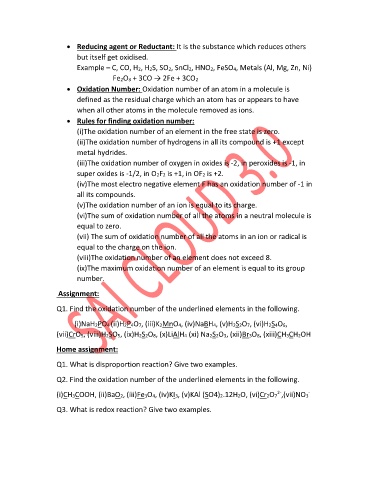
Reducing agent or Reductant: It is the substance which reduces others
but itself get oxidised.
Example – C, CO, H2, H2S, SO2, SnCl2, HNO2, FeSO4, Metals (Al, Mg, Zn, Ni)
Fe2O3 + 3CO → 2Fe + 3CO2
Oxidation Number: Oxidation number of an atom in a molecule is
defined as the residual charge which an atom has or appears to have
when all other atoms in the molecule removed as ions.
Rules for finding oxidation number:
(i)The oxidation number of an element in the free state is zero.
(ii)The oxidation number of hydrogens in all its compound is +1 except
metal hydrides.
(iii)The oxidation number of oxygen in oxides is -2, in peroxides is -1, in
super oxides is -1/2, in O2F2 is +1, in OF2 is +2.
(iv)The most electro negative element F has an oxidation number of -1 in
all its compounds.
(v)The oxidation number of an ion is equal to its charge.
(vi)The sum of oxidation number of all the atoms in a neutral molecule is
equal to zero.
(vii) The sum of oxidation number of all the atoms in an ion or radical is
equal to the charge on the ion.
(viii)The oxidation number of an element does not exceed 8.
(ix)The maximum oxidation number of an element is equal to its group
number.
Assignment:
Q1. Find the oxidation number of the underlined elements in the following.
(i)NaH2PO4 (ii)H2P4O7, (iii)K2MnO4, (iv)NaBH4, (v)H2S2O7, (vi)H2S4O6,
(vii)CrO5, (viii)H2SO5, (ix)H2S2O8, (x)LiAlH4 (xi) Na2S2O3, (xii)Br3O8, (xiii)CH3CH2OH
Home assignment:
Q1. What is disproportion reaction? Give two examples.
Q2. Find the oxidation number of the underlined elements in the following.
2-
-
(i)CH3COOH, (ii)BaO2, (iii)Fe3O4, (iv)KI3, (v)KAl (SO4)2.12H2O, (vi)Cr2O7 ,(vii)NO3
Q3. What is redox reaction? Give two examples.

