


Page 2 - LN
P. 2
Now, as per the division algorithm,
               Divisor x Quotient + Remainder = Dividend
                       2
                 3
               (x  – 3x  + x + 2) = g(x) (x – 2) + (–2x + 4)
                       2
                 3
               (x  – 3x  + x + 2 + 2x -4) = g(x) (x – 2)
                 3
                       2
               (x  – 3x  + 3x - 2) = g(x) (x – 2)
                                                                     2
                                                               3
               Hence, g(x) is the quotient when we divide (x  – 3x  + 3x – 2) by (x – 2).
                                    2
               Therefore, g(x) = (x  – x + 1).
                                                                                                        3
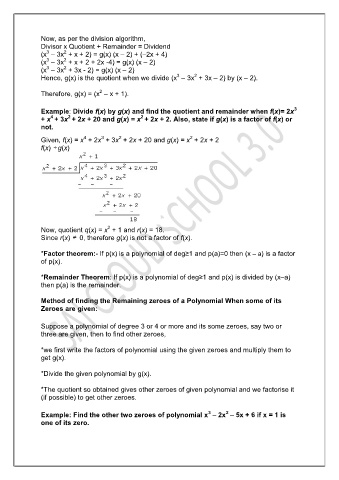
               Example: Divide f(x) by g(x) and find the quotient and remainder when f(x)= 2x
                         2
                                                  2
                   4
               + x + 3x + 2x + 20 and g(x) = x + 2x + 2. Also, state if g(x) is a factor of f(x) or
               not.
                                     3
                                                                    2
                                           2
                              4
               Given, f(x) = x  + 2x  + 3x  + 2x + 20 and g(x) = x  + 2x + 2
               f(x)  g(x)


                                       2
               Now, quotient q(x) = x  + 1 and r(x) = 18.
               Since r(x)   0, therefore g(x) is not a factor of f(x).

               *Factor theorem:- If p(x) is a polynomial of deg≥1 and p(a)=0 then (x – a) is a factor
               of p(x).

               *Remainder Theorem: If p(x) is a polynomial of deg≥1 and p(x) is divided by (x–a)
               then p(a) is the remainder.

               Method of finding the Remaining zeroes of a Polynomial When some of its
               Zeroes are given:


               Suppose a polynomial of degree 3 or 4 or more and its some zeroes, say two or
               three are given, then to find other zeroes,


               *we first write the factors of polynomial using the given zeroes and multiply them to
               get g(x).

               *Divide the given polynomial by g(x).

               *The quotient so obtained gives other zeroes of given polynomial and we factorise it
               (if possible) to get other zeroes.


                                                                                2
                                                                          3
               Example: Find the other two zeroes of polynomial x  – 2x  – 5x + 6 if x = 1 is
               one of its zero.

